
For the longest time, people have wrestled with reconciling divine sovereignty and human responsibility, often asking, ‘If God’s sovereign decrees and plans cannot be resisted or thwarted by human decisions and actions, how can God hold us responsible for those decisions and actions?’
Even the Apostle Paul, a man of substantial theological insight, had to come to terms with this. However, his engagement with it did not terminate in a vexing conundrum, but a practical recognition of one simple truth: Because God is sovereign, humans are responsible.
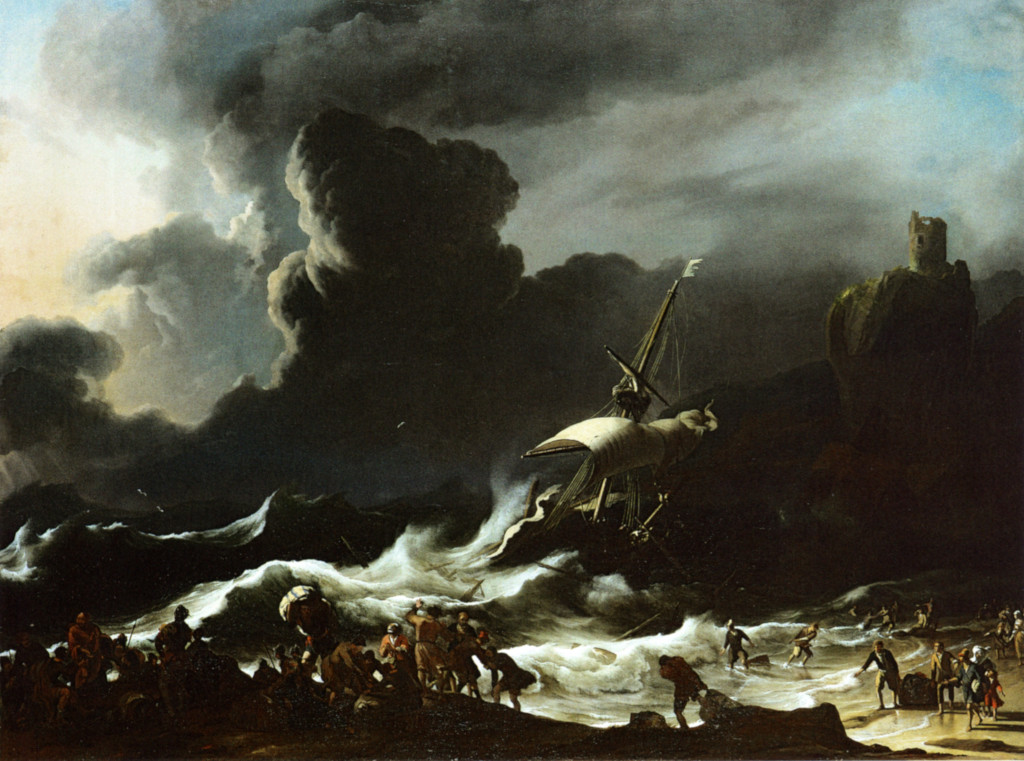
For Paul, this issue was never a matter of academic speculation but practical relevance to life. We see this in the New Testament book of Acts, where His understanding works out in the context of a life-threatening disaster–an immanent shipwreck. The missionary apostle was one of the prisoners being transported by the authorities to Rome via a sea-faring ship, the occupants of which had endured treacherous storms for two weeks.
We enter the story at the point where the situation had become desperate…
Since they had been without food for a long time, Paul stood up among them and said, “Men, you should have listened to me and not have set sail from Crete and incurred this injury and loss. Yet now I urge you to take heart, for there will be no loss of life among you, but only of the ship. For this very night there stood before me an angel of the God to whom I belong and whom I worship, and he said, ‘Do not be afraid, Paul; you must stand before Caesar. And behold, God has granted you all those who sail with you.’ So take heart, men, for I have faith in God that it will be exactly as I have been told. But we must run aground on some island.”
When the fourteenth night had come, as we were being driven across the Adriatic Sea, about midnight the sailors suspected that they were nearing land. So they took a sounding and found twenty fathoms. A little farther on they took a sounding again and found fifteen fathoms. And fearing that we might run on the rocks, they let down four anchors from the stern and prayed for day to come. And as the sailors were seeking to escape from the ship, and had lowered the ship’s boat into the sea under pretence of laying out anchors from the bow, Paul said to the centurion and the soldiers, “Unless these men stay in the ship, you cannot be saved.” Then the soldiers cut away the ropes of the ship’s boat and let it go. As day was about to dawn, Paul urged them all to take some food, saying, “Today is the fourteenth day that you have continued in suspense and without food, having taken nothing. Acts 27:20-33 (ESV)
At the eleventh hour, Paul reveals to the ship’s company that an angel of God had appeared to him and confirmed that he, and all on board the stricken vessel, would survive the calamity. Now, you might assume if God had decreed their safety by miraculously revealing the same to Paul, then the apostle would confidently assert that no amount of human action could affect the outcome–well, not so!
According to the account, the ship’s sailing crew had secretly attempted to abandon ship, leaving the stricken passengers to test the validity of Paul’s prediction. On becoming aware of the situation, Paul alerted the Centurion with words that might be construed as contradicting the content of the previous divine revelation, “Unless these men stay in the ship, you cannot be saved.”
What are we to make of this?
God has revealed by decree to Paul that no one would be lost, and yet within a very short time Paul is asserting that the salvation of all was dependant on the human effort of a few unwilling sailors.
However, for Paul there is no logical conflict, he simply understood that divine sovereignty necessitates human responsibility. The apostle believed that divine revelation is not merely given as information to be pondered, but truth that demanded responsible action. Personally applied, we could say that if God has revealed something relevant to you, the responsibility is now placed on you to do something about it. Thus, personally relevant divine decrees carry with them a demand on human responsibility; to act within your capacity according to the ‘intent’ of that revelation. Indeed, we see this in two other examples of this in the New Testament…
Firstly, in Paul’s encouragement to the Philippian Christians, ‘Therefore, my beloved, as you have always obeyed, so now, not only as in my presence but much more in my absence, work out your own salvation with fear and trembling, for it is God who works in you, both to will and to work for his good pleasure.‘ Philippians 2:12-13 (ESV) Although salvation is a divinely sovereign initiative, he nevertheless exhorts believers to work diligently, at the human level, to prove their faith through holy obedience, knowing that such working is empowered by God, whose goal is to work ‘through ‘ their willing actions to accomplish his divine decree of salvation.
Secondly, the following passage from Peter’s second epistle confirms that the eternal decree of election behoves validation ‘in time and space’ through responsible action, ‘Therefore, brothers, be all the more diligent to make your calling and election sure, for if you practice these qualities you will never fall.’ 2 Peter 1:10 (ESV) According to this scripture, what guarantees the surety of election ‘for the believer’? Practical diligence arising from a knowledge of God’s will. Rather than being the cause for inactivity, a knowledge of God’s eternal decrees spurs on the sincere believer to responsibly confirm that election within their own experience of obedient conformity. So, in this case, God’s sovereignty does not just necessitate responsible action, it inspires it!
Paul and Peter both understood that a knowledge of God’s will should never be a cause for benign passivity. On the contrary, the revelation of God’s will demands and inspires responsible action, with a view to confirming what God has decreed, and thus proving one’s obedience to God’s lordship in the process. Because God is sovereign (Lord) then the servant of the Lord is compelled by love and devotion, to do everything within their human power to validate that which they understand to be God’s revealed will.
Nevertheless, if some of the human agents are not agreeable to decree arising from God’s revealed will, deliberately choose to resist it, even they cannot thwart it’s ultimate outcome. In fact, we see this played out in the shipwreck account. The unwilling sailors on the sinking ship, could not avoid playing their part in fulfilling God’s revealed plan. God had decreed the ship’s company would be saved, Paul knew that the sailors were instrumental to that salvation process and acted responsibly to insure the sailors conformed to the plan. Though the sailors were unwilling, ‘circumstances’ intervened to force their compliance, and by their actions God’s decreed was fulfilled.
If the matter is this simple, why is it a problem for so many?
I suspect the answer lies with a competing theological conviction, which is simply this: Human sovereignty and divine responsibility. That is to say, all humans, whether they embrace Christian truths or not, have an innate sense of human sovereignty. Closely associated with this ideal is the attending belief, that the role of ‘any’ divine being exists to assist the sovereign human self, accomplish its goals. As such, deities are placated or manipulated to supernaturally grant the wishes of the religious devotee, to the ends that their ‘sovereign’ plans will might be accomplished. Personally applied, ‘It is my right to accomplish ‘this goal’ (albeit in God’s name) and it is God’s responsibility to help me do it!’ Consequently, the notion that God should hold ‘me’ responsible for resisting his will is personally offensive, because it directly conflicts with the notion of ‘my’ sovereignty.
Hence, the real issue in coming to terms with this perceived theological conundrum, is not intellectual complexity at all, but moral rebellion– a proud unwillingness to come to accept what a human being really is in relation to the one true God!
Something Paul, bluntly points out in his Roman’s letter….
You will say to me then, “Why does he still find fault? For who can resist his will?” But who are you, O man, to answer back to God? Will what is moulded say to its moulder, “Why have you made me like this?” Has the potter no right over the clay, to make out of the same lump one vessel for honoured use and another for dishonourable use? Romans 9:19-21 (ESV)
In fact, the issue of responsibility is solved, once the issue of competing sovereignties is resolved.
Humans are subordinate, finite beings who do not have the unlimited capacity of their divine creator. Yet, they have been created with a free will and the power of choice, for which they will ultimately give an account to God. Because humans are accountable, correspondingly they are responsible–responsible to act within their limited powers to conform to God’s revealed will, as they have the capacity to understand it. Responsibility has to be placed in its proper context; human responsibility operates in the realm of mundane process, divine responsibility extends further into the realm of ultimate destiny e.g. Paul was responsible in the process of the ship’s company being saved, God was responsible for the outcome of that salvation.
In the end, God’s sovereign control does not negate human responsibility, it simply helps us put it into perspective.


Hi Roland,
Thanks for the article. A clear word on a contentious issue.
We are still vacant at WPC Redbank Plains, and our preacher’s are working through Philippians.
I pray you and family are well.
Blessings, Keith
LikeLike